Connecting the Global Copper Story to Indian Equities
Part 2 of the copper story. A higher copper price does not help every copper-related company in the same way — it depends on where the company sits in the value chain, whether growth is coming from price or volume, and whether margins are actually improving. Hindustan Copper, Hindalco, Vedanta, Jain Resource Recycling, Polycab, KEI, RR Kabel, Finolex, Ram Ratna and Precision Wires, each run through the same five questions.
In Part 1, the global copper story came down to a few simple points: mine supply is difficult to expand quickly, copper concentrate is especially tight, treatment charges have collapsed, and long-term demand is being supported by grids, renewables, EVs, data centres and industrial electrification.
Part 2 asks a different question: what do those same developments mean for Indian companies?
The first mistake would be to say: “Copper prices are rising, therefore all copper-related Indian companies will benefit.”
Different companies sit at different points in the copper chain, so the same copper rally can help one business while creating pressure for another.
The copper chain, made simple
Stage in the chain
Where Indian companies sit
Mine
Hindustan Copper
Concentrate
The raw material smelters need
Smelter / refinery
Hindalco, Vedanta, Kutch Copper
Copper products
Ram Ratna Wires, Precision Wires
Wires and cables
Polycab, KEI, RR Kabel, Finolex
The easiest way to connect Part 1 to Indian companies is to take each global development and ask what it does here.
Global copper story
What it means in India
Copper prices rise
Miners can earn better realisations. Downstream companies may also report higher revenue because selling prices rise.
Copper concentrate becomes scarce
Miners producing concentrate gain bargaining power; smelters face a harder raw-material environment.
Treatment charges fall
This generally pressures smelting economics, although by-products can offset part of the impact.
India electrifies
Demand rises for wires, cables, winding wires, transformers and electrical equipment.
Primary supply stays constrained
Recycling and raw-material security become more important.
The five-question checklist I will use
To keep the company analysis simple, every company is run through the same five questions.
Are sales growing quickly? First sign of momentum, but copper inflation can distort this.
Are actual volumes growing? Separates real business growth from higher copper prices.
Is EBITDA growing faster than sales? Shows operating leverage and better earnings quality.
Are EBITDA and PAT margins expanding? Shows whether growth is becoming more profitable.
Is there visibility that this continues? Capex, capacity, management guidance and demand determine what happens next.
Hindustan Copper: closest to the mine
Hindustan Copper is the easiest company to connect with Part 1 because it owns copper mines and produces copper concentrate. Concentrate is exactly the part of the global market that has become particularly tight.
Think of Hindustan Copper in the simplest possible way: it mines copper ore, processes that ore into copper concentrate, and can then either sell that concentrate or process it further into refined copper.
In FY26, the amount of copper concentrate it produced increased only from 25,241 tonnes to 27,421 tonnes, which is about 9% growth.
But its sales increased about 49% and PAT nearly doubled. So the big jump in profit did not come mainly from producing much more copper. It came because the copper it was selling was worth much more. Volume grew only 9%, but revenue grew much faster because the price per unit increased sharply.
Hindustan Copper can take its concentrate and process it further into copper cathode and wire rod. But in FY26, it chose not to do that with its own concentrate.
Why? Because management said it was getting better realisation by selling the concentrate directly.
So instead of mine copper → make concentrate → refine it → sell cathode, it chose mine copper → make concentrate → sell concentrate.
The logic is: “If buyers are already willing to pay me a very attractive price for the concentrate, why spend more money processing it further?”
And this connects directly to Part 1. Concentrate is scarce globally, and smelters need concentrate to run their plants. So when concentrate is scarce, the company that owns the concentrate has a stronger position.
That is why Hindustan Copper’s FY26 story can be reduced to just this: it produced a little more copper, but it earned much more because copper and concentrate became more valuable.
Going forward, the real opportunity would be higher copper prices and much higher production volumes. That would give Hindustan Copper both price growth and volume growth.
Checklist
Hindustan Copper
Sales growth
Strong: +49% in FY26
Volume growth
Positive, but production grew only ~9%
Earnings growth
Very strong: PAT nearly doubled
Future growth visibility
Depends heavily on mine expansion
Main question
Can production growth now accelerate?
The current story is roughly: better copper economics + modest production growth = very strong earnings growth. The stronger future story would be: supportive copper economics + much faster production growth = price and volume working together.
Hindustan Copper plans to expand mining capacity from around 4 MTPA towards 12.2 MTPA. That makes execution of the mining expansion more important than simply watching the copper price.
This entry is part of the members' archive. The full note continues for another eleven paragraphs, along with the underlying working and the spreadsheet built while reading through the filings.
It closes with the two questions worth putting to management on the next call, and what would have to change for the view to change with it.
Copper hit an all-time high on the LME and then held there even after the Fed raised rates. Two separate things are driving it — the world’s biggest mines are struggling to produce, and the threat of a US tariff has pulled a huge share of the world’s exchange copper into American warehouses. Yet some forecasters still expect a small surplus in 2026. How all of that can be true at once.
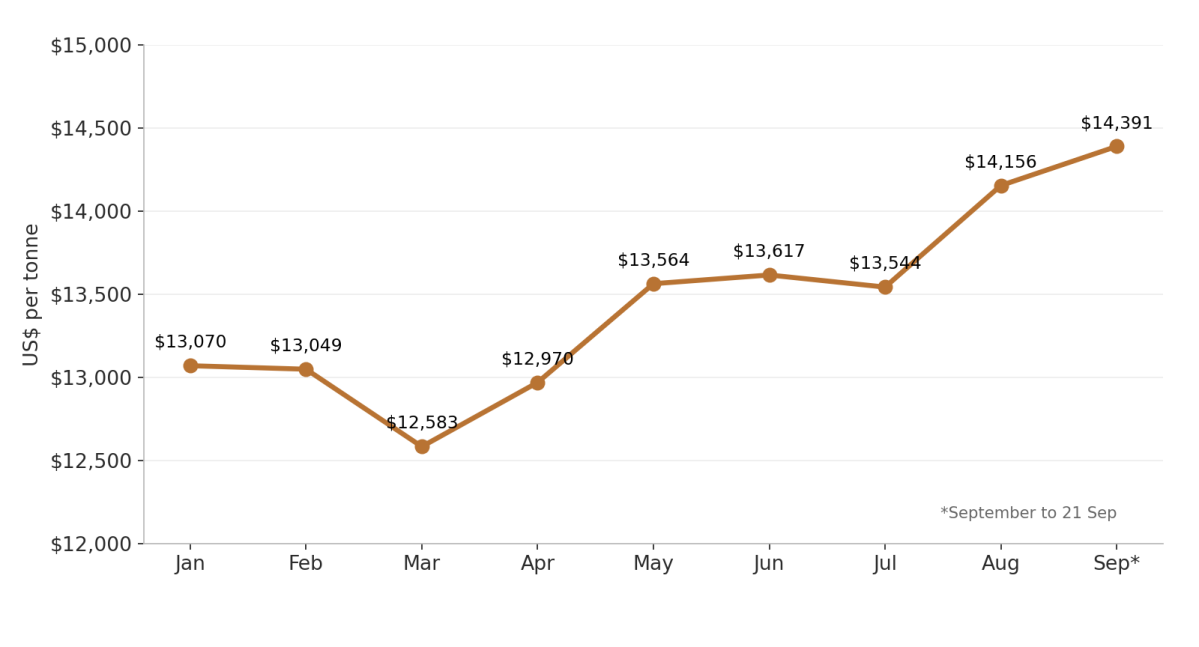
On 10 September 2026, copper touched an all-time high of $14,875 a tonne on the London Metal Exchange (LME). By 22 September, the three-month price was back at $14,760, close to that record.
Copper has climbed through 2026 (LME three-month price, monthly average). Source: LME official prices via Westmetall. September average covers 1 to 21 September.
Here is the interesting part. On 16 September, the US Federal Reserve raised interest rates by 0.25%, from 3.75% to 4.00%. Higher rates usually hurt industrial metals, because they slow down building, manufacturing and the wider economy. Copper went up anyway.
Two things are driving this.
First, the world’s biggest copper mines are struggling to produce more. Several have had serious setbacks, and new mines take many years to build.
Second, the chance of a US tax on imported copper has pushed traders to pile huge amounts of copper into American warehouses. That leaves less copper for buyers everywhere else.
But there is a twist. Despite all these problems, some forecasters still expect the world to produce slightly more refined copper than it uses in 2026.
How can all of this be true at once? To answer that, we need to look at how the copper market works.
Why copper matters
Copper carries electricity very well. That is why it is used in wiring, power lines, motors, transformers, vehicles and factory equipment.
Three areas matter most for future demand.
Power grids. As countries build more power plants and transmission lines, they need more cables, transformers and substations.
Electric vehicles. EVs use copper in their motors, batteries, wiring and chargers.
AI and data centres. Data centres need a lot of electrical equipment: power cables, transformers, cooling systems and backup power.
These are long-term sources of demand. But that does not mean people will buy copper at any price. When copper gets very expensive, manufacturers can delay purchases, use recycled copper, or switch to aluminium where they can.
So the real question is whether copper production can keep up.
The world’s copper mines are struggling
Normally, when prices rise, producers dig more. Copper doesn’t work that simply.
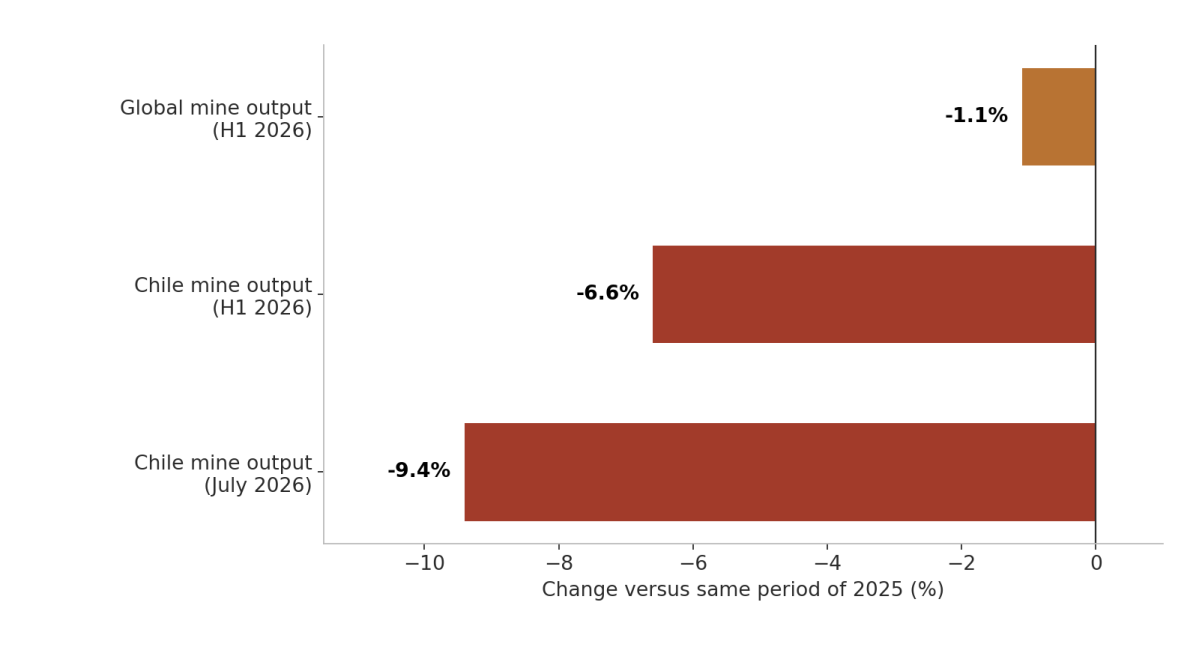
Global copper mine production fell 1.1% in the first half of 2026, even though prices were at records. If that does not recover, 2026 could be the first year since 2017 in which world mine output falls.
Mines are producing less copper, not more. Source: Sprott Asset Management, "Copper’s Rally Meets a Deepening Supply Crunch", 15 September 2026, citing International Copper Study Group (ICSG) data.
Chile, the world’s largest producer, is a big part of the problem. It produced about 23% of the world’s mined copper in 2025. Its output fell 6.6% in the first half of 2026 and another 9.4% in July.
Chile’s state copper commission, Cochilco, has cut its 2026 forecast to 5.27 million tonnes. Several large miners have also lowered their targets as they deal with accidents, bad weather and ageing mines.
Two mines show just how fragile copper supply can be.
Trouble at two major mines
Grasberg, Indonesia
Grasberg, run by Freeport-McMoRan, is the world’s second-largest copper mine. In September 2025, a mud rush flooded part of the underground mine and killed seven workers.
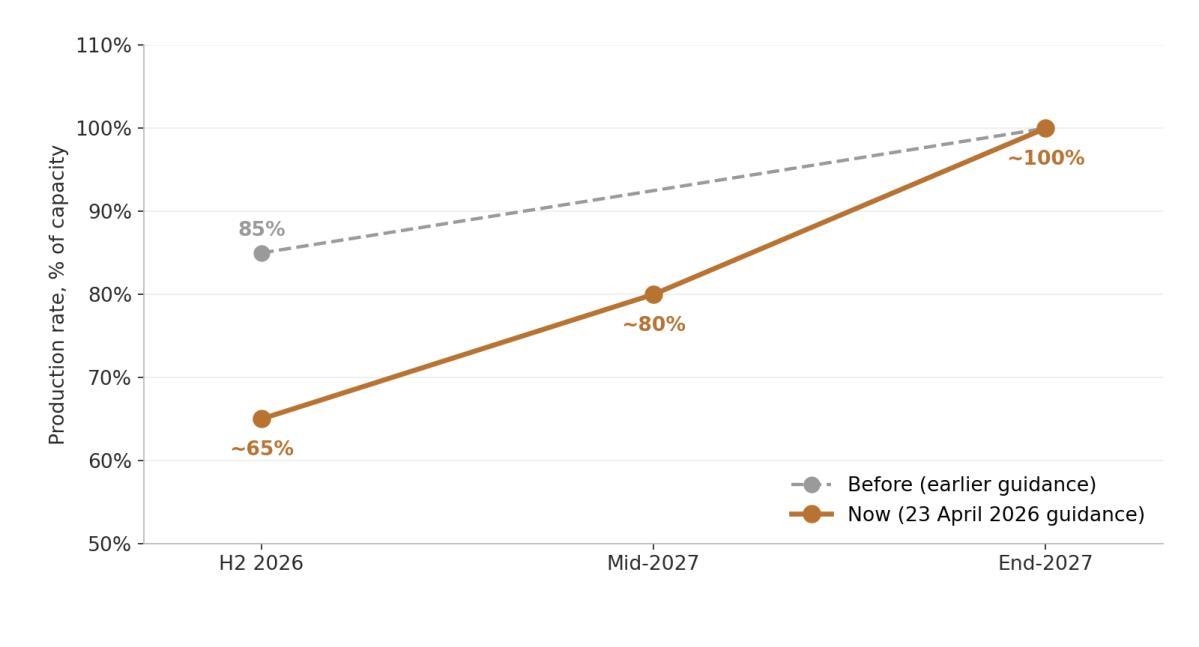
Mining restarted gradually from March 2026. Freeport expects its Indonesian operations to run at about 65% of normal in the second half of 2026, about 80% by mid-2027, and close to full capacity by the end of 2027. These are company targets, so the actual recovery still needs watching.
Figure 3. Grasberg’s recovery will take longer than first planned. Source: Freeport-McMoRan, first-quarter 2026 results, 23 April 2026 (SEC Form 8-K, Exhibit 99.1).
This entry is part of the members' archive. The full note continues for another eleven paragraphs, along with the underlying working and the spreadsheet built while reading through the filings.
It closes with the two questions worth putting to management on the next call, and what would have to change for the view to change with it.
Everything you need to understand the industry, and how to read the September 2026 quarter when it lands. How the money actually moves from factory to wall, why the tinting machine is the only distribution number worth tracking, what Birla Opus has permanently taken away, and a company-by-company scorecard with the exact thresholds to check.
PART 1: HOW THIS INDUSTRY WORKS
Follow the money from the factory to your wall
You repaint your house every four to six years. That is the whole demand cycle of this industry in one sentence. Not when you build a house, when you repaint one. Hemant Jalan of Indigo Paints made this point directly on the February 2026 call, saying new construction accounts for a very small part of paint purchase and the major part is repainting.
This matters more than it sounds. It means paint demand does not track real estate. It tracks how people feel about spending money on their home, which is a much softer and more emotional thing.
Now follow the transaction. You decide to paint. In most cases you do not choose the product, your painter does, or he narrows it to two options. You or he goes to a dealer shop. You pick a shade from a card. The dealer takes a can of white base paint and mixes your shade into it on the spot.
Four parties, four different incentives:
The company makes the paint, sells it to the dealer at a list price, and spends heavily on advertising so you ask for its brand by name.
The dealer buys from the company and sells to you. He earns the difference. He also earns a second thing that matters enormously: a back-end rebate from the company, paid periodically based on how much he sells.
The painter is the actual decision maker in most households. Every company runs a loyalty programme for him. Kansai Nerolac's Pragati programme covered 65,000 painters in a single quarter. Birla Opus discloses roughly 4.5 lakh active contractors and painters.
You mostly choose a brand and a colour, and defer on the rest.
Two ways paint reaches you, and why the difference decides everything
This is the single most useful thing to understand about the industry, so it is worth going slowly.
Ready-made cans. Paint that already has colour in it. Made in the factory, shipped coloured, sits on a shelf. You buy it as it is. But only a handful of shades are worth making this way, mostly whites and a few popular colours. No company can manufacture two thousand different shades and ship them to thousands of shops.
Machine-mixed paint. This is how almost everything else is sold. The company ships plain white base paint to the shop. The shop has a tinting machine, which holds cartridges of concentrated colourant. You point at a shade on a card, the dealer keys the code into the machine, it injects exact quantities of colourant into the white base, and a shaker mixes it. Your colour gets made in front of you in about five minutes.
Why the tinting machine is the real competitive asset
Three facts, and the conclusion follows on its own.
One. The machine belongs to the paint company, not the dealer.
This entry is part of the members' archive. The full note continues for another eleven paragraphs, along with the underlying working and the spreadsheet built while reading through the filings.
It closes with the two questions worth putting to management on the next call, and what would have to change for the view to change with it.
India’s listed broking platforms after Q1 FY27: Groww vs Angel One
Billionbrains Garage Ventures (Groww) and Angel One both reported Q1 FY27 in mid-July. One grew revenue 66%, the other 25%. That gap is the story.
Setting up the story
Q1 FY27 was calm after a brutal Q4 FY26. The war-driven volatility that inflated derivatives volumes in Q4 faded, and with it trading activity declined. According to NSE data, NSE active clients declined by roughly 257,000 for the industry in Q1 FY27. New demat additions at the depositories were soft. Both managements said July began weak, and both declined to extrapolate the next fifteen days.
As we know, this is a sector where regulations can have a big impact.
First, the RBI has introduced rules around how much banks can lend to capital-market businesses, which could make it harder for brokers to access short-term funding. However, Angel One's CFO said the impact should be limited because it relies on multiple sources of funding, including NBFCs, NCDs and commercial paper.
Second, there was a report during the results season that margin requirements for trading on expiry days could increase. Groww's CFO said this was news to the company as well, and that they had not seen any clear impact from the earlier increase in the additional margin requirement.
So neither company appears particularly worried at this point. But regulations are still something they cannot ignore. At least half of both companies' revenue is linked, either directly or through interest income, to trading activity. Any major change that affects trading volumes could therefore have an impact.
Groww: how the machine works
Billionbrains Garage Ventures is the listed holding company. It does almost nothing itself except own things and run the broking book. The pieces that matter:
Groww Invest Tech, the broking arm — stocks, equity derivatives, commodity derivatives and the Margin Trading Facility book.
Groww Creditserv Technology, the in-house NBFC — personal loans and Loans Against Securities on own balance sheet.
Groww Asset Management plus Groww Trustee. State Street Global Advisors has agreed to put in up to ₹580 crore for a 22.94% economic interest, and now has both CCI and SEBI clearance.
Finwizard Technology (Fisdom), the wealth business bought for ₹961 crore in October 2025.
Assorted others: Groww Pay, Groww Insurance Broking, and Groww IFSC, the GIFT City entity that will house US stocks.
Sixteen entities in the consolidation as of 31 March 2026. One reportable segment, because management tells the board it runs the whole thing as one platform.
You download the app for a free mutual fund SIP. Groww earns nothing on it, because it sells direct mutual fund plans that pay no commission. What Groww has won is your presence: your money now lives on its platform. From there:
You buy stocks, and pay brokerage on every order.
You try equity derivatives — contracts that let you bet on where a stock or index will go, using far less money than buying the shares outright. Groww charges a flat ₹20 per order. Because derivative traders place many orders, this is the biggest fee pool in Indian broking, and also the one regulators worry about most, since most retail traders lose money in it.
You take a Margin Trading Facility loan: you buy more shares than your own cash would allow, Groww lends you the difference, keeps the shares as collateral, and charges 14.95% interest. Groww earns interest on the loan and brokerage on the larger trade.
Your idle cash earns Groww float income — interest on customer money parked overnight.
Groww's in-house lending company gives you a personal loan, or a Loan Against Securities where you pledge mutual funds or shares and borrow against them without selling anything.
One customer, four streams: fees, loan interest, float interest, and distribution income. The magic is that Groww's costs barely rise when you do more. About 90% of its costs are fixed, and the whole platform runs on roughly 1,350 employees. So when revenue grows, most of it drops straight into profit.
Groww's product mix, and how it moved
Share of total income
Q1 FY26
Q4 FY26
Q1 FY27
What it tells you
Equity derivatives
56.4%
54.8%
52.0%
Still more than half the business, but shrinking as a share
Stocks
19.3%
16.4%
16.4%
Steady; stock trading volumes grew 48% YoY
MTF (lending to buy stocks)
3.0%
6.9%
8.0%
The fastest riser; the loan book grew 264% in a year to ₹3,775 crore
Float (interest on idle cash)
9.9%
7.6%
8.1%
Stable and quietly valuable
Commodity derivatives
~0%
4.5%
4.9%
Did not exist before Sep 2025; already 28.6% retail market share
A year ago Groww was mostly a derivatives shop with a mutual fund funnel attached. It is turning itself into a diversified platform where lending and new products do more of the work. The change is real. But be careful with percentages: even though the derivatives share fell, derivatives still supplied about 45% of the extra rupees Groww earned this year, because the whole pie grew.
Groww's Q1 FY27 numbers
Total income ₹1,549 crore, up 63% YoY and up about 1% from Q4. EBITDA up 100% to ₹971 crore at a 64.7% margin. Profit after tax ₹735 crore, up 94%.
Total income was flat QoQ mainly because Q4 was exceptional — war-driven volatility made people trade more, and management called that quarter an anomaly on the call. Even though revenue stayed flat, the quality of that revenue improved. The market was relatively calm, yet the company maintained revenue by replacing some of the more volatile derivatives income with steadier income from MTF and commodities.
Groww added 115,000 net active NSE clients during the quarter, even as the industry as a whole lost 257,000. New customer additions were weak, so this growth appears to have come mainly from existing Groww customers continuing to stay active while customers on other platforms became inactive. In a business where retaining customers is one of the hardest things to achieve, that is a meaningful advantage.
The cost structure tells an equally important story. Revenue grew 63% YoY, while the company's largest cost bucket, largely employee costs, increased by just 2.4%. That is the operating leverage in the model.
Groww's three soft spots
One: Fisdom. Groww acquired the wealth-management business in October 2025 for ₹961 crore. Of this, ₹920 crore was goodwill — the amount paid above the value of Fisdom's identifiable assets, because it believed the business had significant future potential. But nine months later, Fisdom's revenue has actually declined. Asked whether the expected improvement had started to show, the CFO's answer was clear: "No. We haven't yet seen the significant improvement."
Two: net inflows. This is the purest health metric Groww reports — fresh money customers put in, minus money they took out, ignoring market movements entirely. It has fallen three quarters running: ₹26,000 crore, then ₹25,000 crore, then ₹23,000 crore. Total customer assets still grew 22% in the quarter, but mostly because markets went up, not because more money came in.
Three: the base effect. Groww grew 66% this quarter because the year-ago quarter was small. It is always important to see which base the current results are being compared against.
What Groww's concall said about the future
The CEO's framing is simple: Groww's first ten years were about giving people access to financial products. The next decade is about becoming a true wealth management company.
The company is building several products to support that ambition. It plans to launch US stock investing through its GIFT City licence, which has been approved and is currently being tested, with launch expected in the next few months. It is also working on W, a wealth product; MF Prime, an AI-led mutual fund advisory platform; and a bond offering. The AMC has received approval for State Street Global Advisors to acquire around 23% for approximately ₹580 crore.
On MTF, management expects the loan book to grow by ₹600 to ₹700 crore every quarter, assuming market conditions remain supportive. On costs, fixed costs are expected to grow by 10% to 20% annually, while revenue is expected to grow faster.
Angel One: how the machine works
Angel One is a thirty-year-old broker that rebuilt itself as an app, and it runs the same basic structure as Groww with two structural differences.
Share of gross revenue, Q1 FY27
Share
What is happening to it
F&O brokerage
45%
The core engine. Recovered strongly through FY26 after the SEBI crackdown; volumes dipped again this quarter with the market
Interest income
33%
The growth engine. Client funding book hit a record ₹7,152 crore, up 31% in one quarter
Cash equity brokerage
9%
Small but improving: revenue per order rose from about ₹15–16 to ₹19 on a pricing change and a paid value-added plan
Commodity brokerage
6%
Growing with the market; Angel holds roughly half of retail commodity turnover
Depository, distribution and other
7%
Distribution fell this quarter on seasonally weak insurance and lower credit disbursals
Interest income has two sources: interest on the client funding book, which is Angel's version of MTF plus funded receivables; and interest on the deposits Angel must park with exchanges as security.
Then there are the younger businesses, still too small to contribute meaningfully.
Ionic Wealth, a wealth manager for the rich: AUM stood at ₹13,440 crore, up 33% in one quarter. Around 91% is ARR AUM, meaning the assets generate recurring annual fees rather than a one-time commission — the more attractive kind of revenue, because it repeats. Management expects breakeven in three to four years.
Credit distribution: Angel arranged ₹530 crore of loans during the quarter, up 130% YoY. However, the number has declined for three consecutive quarters, from ₹710 crore to ₹610 crore and now ₹530 crore. Management attributed this to lenders recalibrating and some friction in the customer funnel, but said it does not expect further deterioration.
AMC: after 15 months, the business has ₹620 crore of assets. Clearly still a work in progress. Management said the strategy should become clearer over the next three to four quarters, while there has also been churn in the senior team.
LAS on its own books: Angel is piloting lending against securities through its own NBFC, and expects it to become meaningful over the next two to three quarters. The company is investing ₹150 crore into it, along with another ₹150 crore into the wealth business.
Angel One's core business is still the mature trading business, which moves with market activity. MTF is becoming a second growth engine and is scaling well. Wealth, credit distribution and the AMC are still early-stage bets.
Angel One's Q1 FY27 numbers
Gross revenue ₹1,434 crore, up 25.4% YoY, down 2.3% from Q4. Reported EBDAT, basically EBITDA, ₹360 crore, up 85% YoY, at a 32.7% margin. Profit after tax ₹231 crore, up 102% YoY but down 28% from Q4.
Both of those dramatic percentages mislead, in opposite directions.
The 102% profit growth looks heroic only because the year-ago quarter was Angel's worst in years, the bottom of the slump after SEBI's derivatives restrictions. Remember FY26 as a whole: Angel's revenue fell 1.8% and profit fell 22% to ₹915 crore. Q1 FY27 is a recovery quarter, not growth.
The 28% profit decline versus Q4 looks alarming but is mostly seasonal. This quarter carried two months of IPL sponsorship spend — Angel's big annual brand outlay, roughly ₹150 crore per season — against only a few weeks in Q4, plus annual salary increments and fresh employee stock grants. Strip the seasonal items and Angel's normalised EBDAT margin, its own cleaned-up measure, was 43.6% versus 44.4% in Q4. A dip of less than one percentage point. That is the real number, and it sits comfortably inside management's guidance of a 45% to 50% margin for the core broking and distribution business, which the CEO reaffirmed on the call.
The cost story deserves respect too: total employee cost is guided flat at about ₹1,100 crore for FY27, the same as FY26, even after increments, because headcount fell roughly 20% during FY26 — from 4,139 to about 3,300 — with AI absorbing the work.
Angel One's soft spots
Market share is flat: 20.2% of overall retail equity turnover, down 17bps in the quarter, and an analyst put it to management directly that growth is coming from the market rising rather than Angel taking share. NSE active clients declined. Credit distribution has fallen three straight quarters against repeated assurances.
And a retail customer used the earnings call itself to complain about a restrictive stock policy that pushed part of his portfolio to a competitor. The CEO handled it with grace and gave out his own email address, but the exchange tells you where the product experience sits against the digital-native rivals.
What Angel One's concall said about the future
Margin guidance of 45% to 50% on the core business intact, with margin expansion expected beyond that as revenue grows against a flat cost base. Employee costs flat for the year. The new-business burn of 4% of margin this quarter guided to settle at 3% to 3.5% for the full year. Wealth breakeven in three to four years, with management willing to invest more if growth justifies it. LAS scaling within two to three quarters. US stocks via GIFT City here too. And a candid promise of an AMC strategy reveal within three to four quarters.
What to watch
For the sector
Any SEBI move on expiry-day or derivatives margins. The one variable that can reprice both stocks in a day.
Industry NSE active client additions turning positive. Until the industry stops shrinking, everyone's growth engine idles.
For Groww
Net inflows. ₹23,000 crore and falling for three quarters. A fourth decline is a warning this company can give.
MTF book additions against the ₹600 to ₹700 crore per quarter guidance.
The main cost line staying near ₹170 crore a quarter. Above roughly ₹190 crore without explanation, and the margin story cracks.
Fisdom plus AMC revenue, about ₹28 crore this quarter and falling. Against ₹1,400 crore of goodwill on the books, it must turn up.
For Angel One
Normalised margin holding 45% to 50% in Q2 and Q3, which have no IPL excuse.
Credit distribution. Three straight declines against a promise of no more. Q2 tests the promise.
Market share. 20.2% and flat. Watch if growth stays purely market-driven while Groww takes share.
The ₹1,100 crore employee cost line staying flat.
LAS scaling and the promised AMC strategy reveal within three to four quarters.
Which one is fundamentally stronger
On the numbers and the guidance: Groww. It added customers while the industry lost them, which is the single hardest thing to do in this business. Its diversification shows up in the reported mix, not just the strategy slides. And its guidance was specific and checkable: loan book adds per quarter, cost trajectory, launch sequence. But the key risk is that Groww carries 52% of income in the most regulated product in Indian finance.
Angel One is the lower-quality machine with the lower-risk setup. It has already survived the regulatory shock Groww has not yet faced at scale; FY26's 22% profit decline is behind it, not ahead. It pays a dividend, guides costs in hard rupees, runs a larger lending book with a proven risk framework, and owns a human distribution network that grows more valuable as the sector pivots to wealth. What it lacks is what Groww has in abundance: organic pull. Flat market share, shrinking active clients and a three-quarter slide in credit distribution say Angel's flywheel needs the market's help to spin.
14 min read
Members only03 Sept · 13 pages
The shift happening in some Indian auto part makers
The shift happening in auto parts segment.
This entry is part of the members' archive. The full note continues for another eleven paragraphs, along with the underlying working and the spreadsheet built while reading through the filings.
It closes with the two questions worth putting to management on the next call, and what would have to change for the view to change with it.
How ageing grids, data-centre electricity demand and equipment shortages are creating an opportunity for TD Power Systems.
This entry is part of the members' archive. The full note continues for another eleven paragraphs, along with the underlying working and the spreadsheet built while reading through the filings.
It closes with the two questions worth putting to management on the next call, and what would have to change for the view to change with it.
Indian pharma spent thirty years learning to sell cheap. The next decade belongs to whoever can make the hard stuff.
This entry is part of the members' archive. The full note continues for another eleven paragraphs, along with the underlying working and the spreadsheet built while reading through the filings.
It closes with the two questions worth putting to management on the next call, and what would have to change for the view to change with it.
How aerospace supply chains actually work and the theme that makes Indian aerospace sector interesting.
This entry is part of the members' archive. The full note continues for another eleven paragraphs, along with the underlying working and the spreadsheet built while reading through the filings.
It closes with the two questions worth putting to management on the next call, and what would have to change for the view to change with it.
Unravelling the deeper macro theme developing in the Indian pharma space. India got very good at making the same medicine cheaper than anyone else — and that is exactly the skill the market has stopped paying for. What every large Indian pharma company is quietly rebuilding around instead.
I’ve been going through a bunch of Indian pharma companies recently and one common theme keeps coming up.
India has traditionally been very good at one thing in pharma: making generic medicines at scale and at a low cost.
But there is a problem with that model. If 10 companies can make the same generic tablet, eventually everyone starts competing on price. And that is exactly what we are seeing in markets like the US.
So companies are now trying to move into areas where not everyone can compete — complex generics, injectables, inhalers, peptides, biosimilars, specialty drugs, CDMO.
Sounds like a lot of jargon, but the idea is actually simple: make things that are harder to make.
And this isn’t just something I’m concluding. Zydus itself talks about moving from volume-led generics towards higher-value specialty products.
How does the pharma value chain work?
To make this note more readable, let’s first understand how the pharma value chain works. At a very simple level:
A medicine starts with an API, or Active Pharmaceutical Ingredient. Think of the API as the actual chemical that produces the medical effect.
That API is then converted into a finished medicine. This finished medicine is called a formulation.
The formulation then goes through regulatory approvals before it can be sold in a particular market.
So broadly: API manufacturing, then formulation manufacturing, then regulatory approval, and finally the sale of the medicine.
Different Indian pharma companies participate at different points in this chain.
Divi’s is primarily an API and custom-synthesis manufacturer.
Cipla, Torrent, Lupin and Sun Pharma are much more focused on finished medicines.
Laurus participates across APIs, formulations and increasingly CDMO (we’ll come to this later).
What exactly is a generic medicine?
That distinction becomes important when we understand where the industry is moving.
Suppose a global pharmaceutical company discovers a new medicine. It spends years on research, trials and regulatory approvals, and generally gets patent protection around that product.
Once the relevant patent protection expires, other pharmaceutical companies can manufacture equivalent versions of that medicine. Those are called generic drugs.
India became extremely successful at this business. Indian companies developed the capability to manufacture generic drugs cheaply and at enormous scale, and supply them across the world. This has been one of India’s biggest advantages in global pharma.
But there is a problem. If ten companies can manufacture the same generic tablet, eventually the competition becomes largely about price. More competitors enter. Customers negotiate harder. Prices fall. And margins can come under pressure.
Torrent explicitly highlights pricing pressure and price erosion in generic markets such as the US and Germany. Zydus similarly identifies intense generic competition as a risk, and says its response is to move up the value chain through complex products with higher entry barriers.
From simple generics to difficult-to-copy medicines
And this appears to be one of the most important shifts happening across Indian pharma today.
A normal generic could be a relatively straightforward tablet. A complex generic is still based on an existing medicine, but it is much harder to develop and manufacture. Examples include:
inhalers
complex injectables
peptide products
transdermal patches
drug-device combinations
long-acting formulations
Why does complexity matter? Because if a medicine is difficult to manufacture, develop and get approved, fewer companies may be capable of entering that market.
So companies are trying to move away from products where many manufacturers can compete mainly on price, towards products where technical capability, R&D and regulatory expertise create barriers to entry.
Zydus describes this transition very clearly. It says it is moving from volume-led generics towards innovation-driven, high-value specialty segments.
Lupin is building a pipeline with 45+ injectables and 20+ inhalation products, and is also expanding into biosimilars and specialty products.
Cipla is investing in respiratory medicines, peptide injectables, biosimilars, complex formulations and drug-device combinations.
Torrent’s pipeline also includes complex generics, injectables, biologics, oncology and other differentiated products.
So even though these companies have different business models, the direction is similar: make products that are harder for competitors to replicate.
What are biosimilars?
There is another layer above traditional generics.
Many newer medicines are biological drugs, which are much more complicated than normal chemically manufactured medicines. The generic-like equivalent of a biologic is called a biosimilar.
These are significantly harder to develop and manufacture than a normal generic tablet. That is why companies such as Lupin, Zydus, Cipla and others are investing in this area.
Again, the attraction is similar: higher complexity, stronger regulatory requirements, fewer capable competitors.
Sun Pharma is taking this one step further
Most of the discussion so far has been about making increasingly difficult versions of existing medicines. Sun Pharma is also moving towards Innovative Medicines.
Here the company is increasingly participating in medicines that are more differentiated and closer to the traditional global innovative-pharma model. Sun says the contribution of branded generics and Innovative Medicines has steadily increased, reducing its dependence on more commoditised opportunities.
So Sun Pharma is effectively taking the value transition further: not only making more difficult generics, but increasing exposure to differentiated and innovative medicines.
The API manufacturing companies are moving up the value chain too
For companies such as Laurus and Divi’s, the shift looks different. They are not primarily trying to create brands that doctors prescribe. Their opportunity lies in becoming a more important partner to global pharmaceutical companies.
This is where CDMO becomes important. CDMO stands for Contract Development and Manufacturing Organisation.
Imagine a global pharma company develops a new drug. Instead of building every manufacturing capability internally, it can ask a company such as Laurus to help with:
developing the manufacturing process
producing material for clinical trials
scaling manufacturing
supplying the API
eventually manufacturing commercial volumes
So there is a big difference between “sell me 10 tonnes of this API” and “work with me from the development stage and help manufacture this drug for the next several years”. The second relationship is deeper and much more technically involved. That is the CDMO opportunity.
Laurus’ Q1 FY27 numbers show how meaningful this shift has become. CDMO revenue grew 67% YoY and represented around 43% of total revenue. At the same time, revenue grew 29%, EBITDA grew 66% and EBITDA margin increased from 24.8% to 31.8%, with management attributing the improvement partly to favourable business and product mix.
Divi’s also saw a higher contribution from custom synthesis in Q1, with management noting somewhat better margins — although the company cautioned that quarterly mix can be lumpy.
So on the manufacturing side, the shift is essentially: from being a supplier to becoming a development and manufacturing partner.
Why is the industry making this shift now?
There appear to be a few structural reasons.
1. Traditional generics are getting increasingly competitive
This is probably the most basic driver. When many companies manufacture the same generic drug, pricing pressure becomes inevitable. Therefore companies increasingly need products where fewer competitors can enter.
That is why words such as complex, differentiated, limited competition, specialty and biologics keep appearing across these companies’ filings.
2. A large global patent-expiry cycle is coming
A large number of global drugs will lose patent protection over the coming years. Torrent highlights a significant patent-expiry opportunity, while broader industry estimates point to roughly $200 billion+ of branded-drug revenues facing loss of exclusivity by 2030.
When a drug loses exclusivity, generic or biosimilar manufacturers can potentially enter. The important difference this time is that many of the drugs losing exclusivity are increasingly more complicated products and biologics. So you are technically getting access to produce more complex medicine products when the patent expires.
So the opportunity is not simply “who can make the cheapest tablet?” It can increasingly become “who actually has the technical and regulatory capabilities to make this product?” That plays directly into the capabilities Indian pharma companies are currently building.
3. Chronic diseases are creating very large markets
The other major structural opportunity is the growing burden of diabetes, obesity, cardiovascular diseases, oncology, neurological diseases and other chronic illnesses. Torrent highlights increasing cardiovascular and metabolic disease burden, particularly across emerging markets.
GLP-1 drugs are a good current example.
Torrent has launched Semaglutide in oral and injectable formats.
Zydus launched three differentiated Semaglutide formulations in March 2026.
Cipla has also entered obesity treatments through generic Liraglutide, while building peptide capabilities.
So GLP-1 is not the entire pharma theme. But it is a good example of how large chronic-disease markets, patent expiries and improving Indian manufacturing capabilities can come together.
4. Global pharma is outsourcing more work
Another important opportunity is manufacturing outsourcing. Instead of global pharma companies doing everything internally, parts of drug development and manufacturing are increasingly outsourced to specialist partners. That creates opportunities for Indian CDMO companies.
Laurus highlights rising outsourcing and increasing demand for end-to-end development and manufacturing services. Torrent also highlights supply-chain diversification and the China Plus One opportunity for Indian pharmaceutical manufacturing. Even Zydus has entered biologics CDMO through the acquisition of US manufacturing facilities.
So another part of the macro story is India trying to capture a greater share of global pharmaceutical development and manufacturing, not just generic drug sales.
What does all of this mean financially?
This is the most important part from an investing perspective.
It would be incorrect to say: higher-value medicine = automatically higher margin.
Complex products require substantially more R&D, capex, regulatory work, time and execution capability. Some products may also fail or face unexpected competition.
But if the strategy works, a company can potentially move towards fewer competitors, a better product mix, stronger pricing, better utilisation and higher margins.
Laurus already gives us one example where stronger CDMO contribution and better product mix have coincided with significant margin expansion. Cipla management has similarly said upcoming differentiated products carry healthy margins, and that product mix remains important for profitability.
The bigger Indian pharma story
For decades, India’s pharmaceutical advantage was largely low manufacturing cost, large scale and generic medicines.
The next stage companies appear to be trying to build towards is more value addition and complex manufacturing. And that is opening up opportunities across complex generics, inhalers, injectables, peptides, biosimilars, biologics, specialty medicines, Innovative Medicines and CDMO.
So the broader macro theme can perhaps be summed up in one line: Indian pharma is gradually moving from a volume-led industry towards a value-led industry, trying to capture more value from each medicine it develops or manufactures rather than simply producing more medicines.
And that’s where the company-level analysis becomes interesting. Because now the question isn’t just “which pharma company is growing fastest?”
It’s: which company is actually moving up the value chain, how much of its revenue is already coming from these higher-value areas, is that improving margins and returns, and how much of that opportunity is already reflected in the valuation?