Zetwerk: how the business works, and its first quarter as a listed company
Zetwerk listed on 23 October and reported its first quarter as a listed company on 13 November. This note explains how the business works from scratch, why 49% of its revenue is a metals desk, and what Q2 showed. The business model section is open to everyone.
The founder's letter in Zetwerk's first results deck as a listed company says there is "a little bit of Zetwerk" in your coffee machine, your headphones, your metro ride and your laptop. That is probably true, and you would still never see the name, because Zetwerk makes things for other companies to sell under theirs.
So before the numbers, this note starts with what the company actually does, because its two businesses look nothing alike and the headline revenue mixes them together.
The business model: a factory you hire by the order
A large company, say Siemens Gamesa, Acer or a US solar developer, has a drawing of something it needs: a wind turbine part, a laptop motherboard, a power transformer. It sends Zetwerk the drawing or the specification. Zetwerk quotes a price and a delivery date. If it wins the order, it gets the thing made, checks the quality and ships it. Its job ends when the product reaches the customer.
The interesting part is where the thing gets made. There are two routes:
- Captive. Zetwerk's own factories, of which it has more than 25. In H1 FY27 these made 60% of what Zetwerk sold in its manufacturing business.
- Marketplace. One of the partner factories in its network, which Crisil counts among more than 6,000 active suppliers, mostly small and medium businesses. They made the other 40%.
Either way, the customer deals only with Zetwerk, and Zetwerk takes responsibility for quality and delivery.
Why would a small factory want Zetwerk in the middle? The CEO, Amrit Acharya, explained it with his co-founder's family story. A typical small Indian factory runs at only 45–60% of its capacity, because it usually has one big customer. Zetwerk brings it orders from industries it would never have found on its own, and the extra use of idle machines is where Zetwerk's cut comes from.
The software is what holds this together. Zetwerk's AI platform, Zeus, reads a drawing, works out what kind of job it is, and picks partner factories by their past on-time delivery. Its tender tool, ZetSpec, turns a tender document into a full bill of materials in about 10 minutes, against 3–4 days before. That matters because Zetwerk wins only about 20% of what it bids for, so it has to bid a lot: Amrit said winning about ₹8,000 crore of orders in H1 meant bidding for ₹30,000–40,000 crore.
What it makes, from wind turbines to motherboards
The manufacturing business sold ₹4,448 crore in H1 FY27, in three buckets:
- Energy, 64%: solar trackers (the frames that turn panels to follow the sun), solar modules, power and distribution transformers, transformer parts, cables and wind turbine parts. Customers include Nextracker, NTPC, Siemens, CG Power, Hitachi and Siemens Gamesa.
- Precision, 22%: circuit boards for Acer and Samsung, defence electronics for Bharat Electronics, DRDO and the Indian Air Force, and machined and cast parts for EV, aerospace and space companies.
- Capital goods, 14%: storage tanks, pressure vessels, refinery reactors, thermal power plant parts and plant machinery for Tata Steel, Reliance, Indian Oil and Hindustan Zinc.
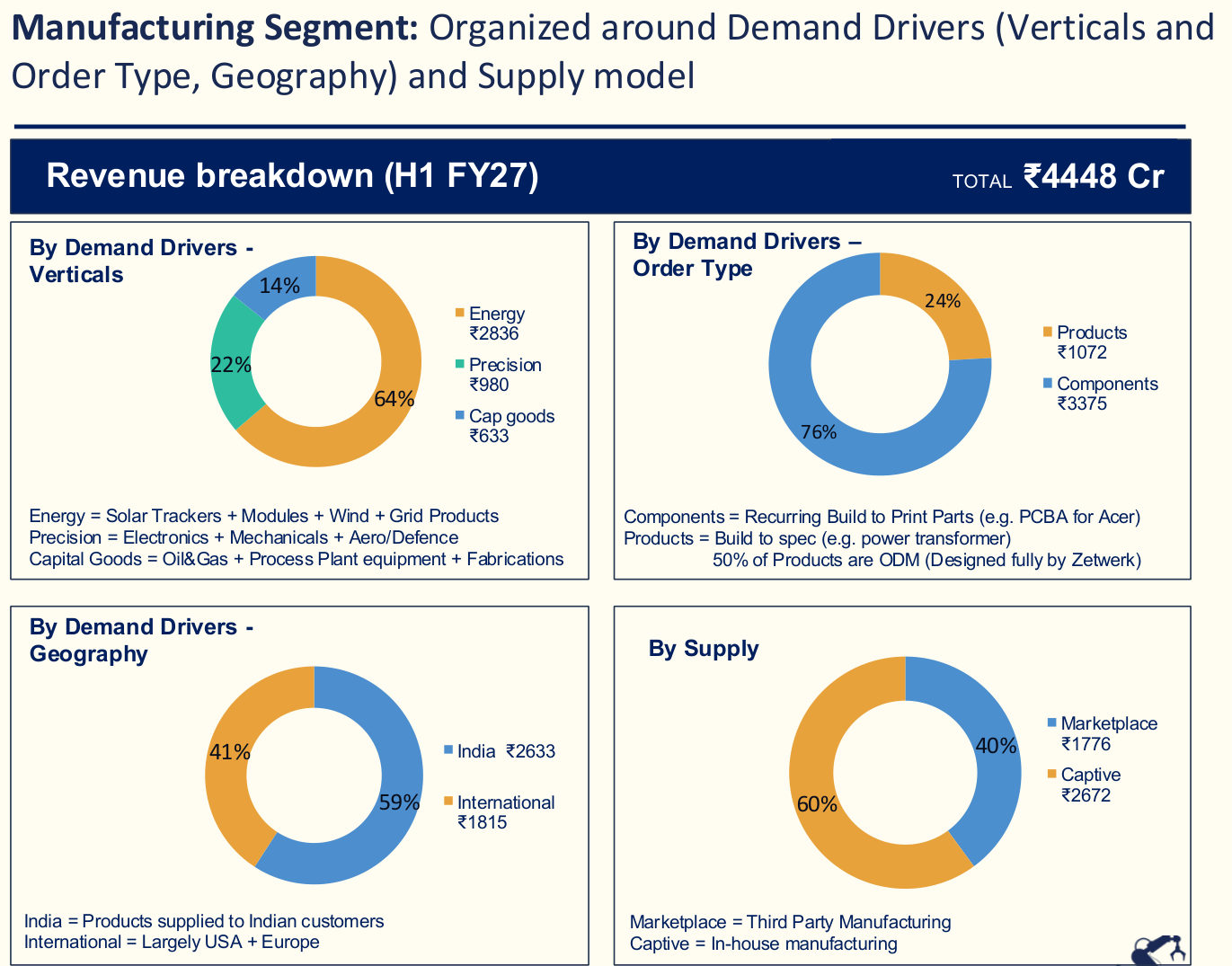
Two other splits matter. 76% of manufacturing revenue is parts made to the customer's own drawing, ordered again and again, like the circuit boards for Acer. The other 24% is larger products built to a specification, and Zetwerk designs about 50% of those itself. And 41% of manufacturing revenue now comes from outside India, mostly the US and Europe, up from 30% in FY26.