Sterlite Technologies: Can AI-led optical demand drive sustainable earnings and return-on-capital expansion?
Sterlite makes the optical fibre, cable and connectivity that carry data between AI computers and across telecom networks. Q1 FY27 revenue reached ₹1,910 crore at a 20.8% EBITDA margin, and the backlog hit ₹18,618 crore. The question is whether margins, cash flow and ROCE can keep pace with management's FY29 ambition. The business model explainer is open to everyone.
Business model
Imagine you want to send a photograph from your phone to a friend on the other side of the world. The information must travel through networks. Much of that journey happens as pulses of light inside very thin strands of glass, called optical fibre.
Sterlite makes those glass strands, protects them inside cables, and supplies the parts that connect those cables to other equipment. A telecom company laying broadband in a city needs fibre cables. A cloud company filling a data centre with AI computers needs thousands of high-density connections. Sterlite supplies the physical connection products both need.
How the chain works
- Glass preform: A highly pure, specially engineered glass rod is created. It is the starting material for drawing optical fibre.
- Optical fibre: The preform is heated and drawn into an extremely thin glass strand through which light signals can travel.
- Optical fibre cable (OFC): Multiple fibres are protected and packaged into a cable that can be installed underground, overhead or in buildings.
- Optical connectivity: Connectors, cable assemblies, pre-terminated trunks and related solutions make the cable easy to attach to switches, racks and other network equipment.
Customers include telecom operators, broadband builders, cloud and data-centre operators, enterprises and public-network projects. They pay for finished fibre, cables or increasingly for bundled optical connectivity products. The main costs are glass/fibre inputs, polymers, industrial gases and speciality materials, energy, manufacturing labour, freight, R&D and equipment depreciation.
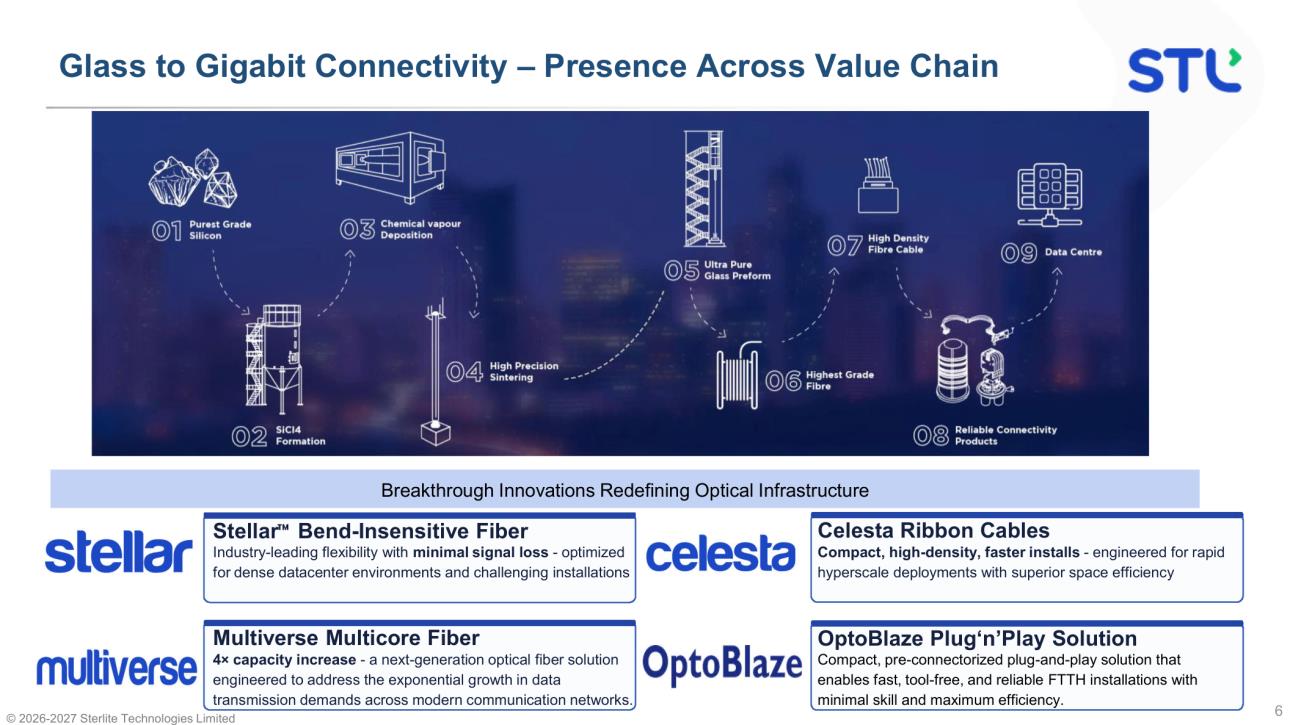
Sterlite's vertical integration matters because it controls more steps from glass to finished connectivity. However, being vertically integrated only becomes an advantage if utilisation, product quality and manufacturing cost remain competitive.