Rossell Techsys analysis
Rossell Techsys builds the wiring inside aircraft, satellites and chip-making machines. It went from a single-customer Boeing supplier to more than thirty customers, and FY26 sales rose 87% to ₹485 crore. The demand story holds up. The financial story does not yet: margin fell, operating cash flow was negative ₹81.6 crore, and the ₹300 crore equity raise is about nine months late. What the company makes is open to everyone.
In one paragraph
Rossell Techsys builds the electrical wiring assemblies that sit inside aircraft, satellites and semiconductor fabrication equipment. For fourteen years it was a single-customer Boeing supplier. It now has more than thirty customers and did ₹485 crore in sales in FY26, up 87%. The demand story is real and order-backed. The financial story is not there yet: EBITDA margin fell despite that scale, operating cash flow was negative ₹81.6 crore, and the ₹300 crore equity raise meant to fund the next leg has been pending for roughly nine months.
What the company actually makes
Let's understand what the company does in simple language. An aircraft has thousands of wires. They connect the radar, the screens in the cockpit, the weapons, the engines. You cannot just leave those wires loose inside. They would rub against each other and break. And no mechanic could ever find a fault in that mess. So a supplier makes them into one ready-made bundle.
Every wire cut to the right length. The whole thing wrapped in a protective cover. Plugs fixed on both ends. Every wire labelled so you know which is which. It ends up looking like a stiff tree of cable with branches. The mechanic just lifts it into the plane in one go and plugs it in. That is the product.
Now here is the important part. A satellite needs the same thing. So does a machine in a chip factory. Same wires, same plugs, same paperwork. Only the customer is different. That is how a company making Boeing harnesses ended up selling to satellite and chip companies without changing what it does.
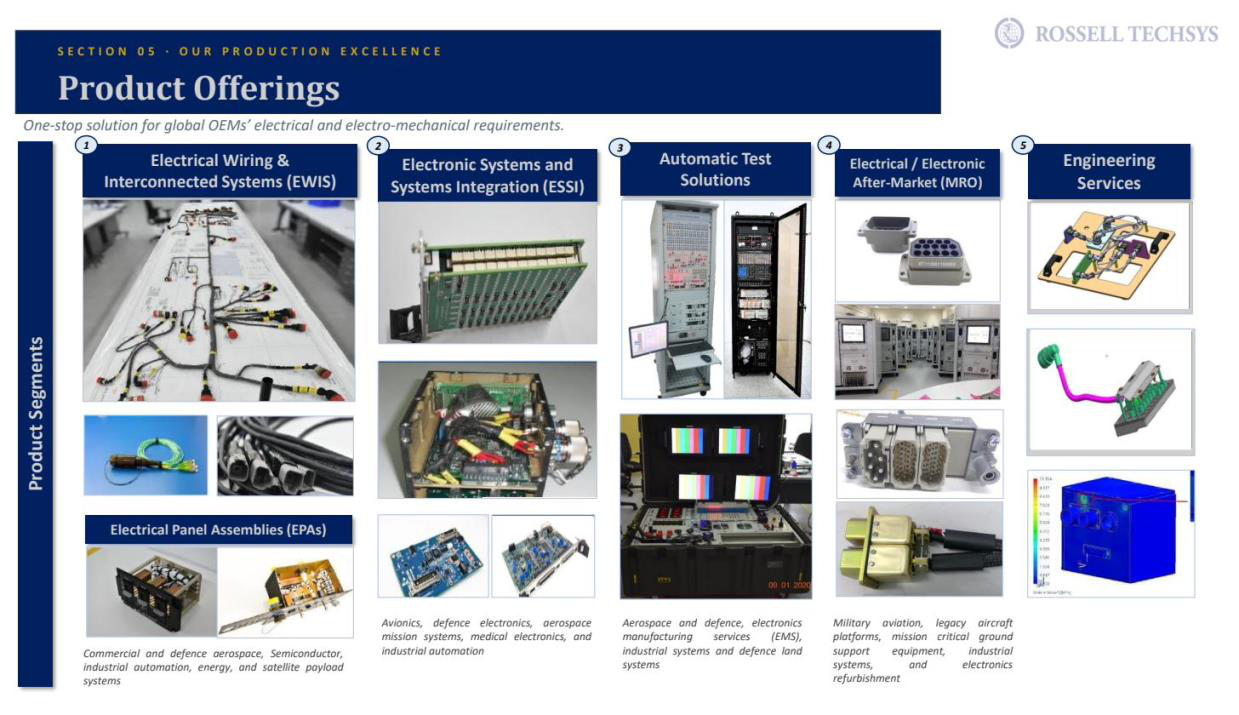
In aerospace this is called EWIS, Electrical Wiring and Interconnection Systems, and it is approximately 70% of Rossell's revenue. In simple language, it is the wiring harness systems for the different segments: aircraft, defence, semiconductor and space.
The remaining 30%
Four adjacent lines, all built on the same assembly and documentation discipline:
- Electrical Panel Assemblies (EPA): a metal box with switches and safety devices already fitted and wired inside. It comes closed and tested. The customer just bolts it into the aircraft and connects two plugs.
- Electronic Systems (ESSI): circuit boards with all the small parts fitted on them, then built into a finished working unit. These go into cockpit electronics, defence equipment and factory machines.
- Automatic Test Solutions (ATE): a tall rack full of instruments. The customer plugs a part into it and it tells them pass or fail. Note where this one goes. It does not go into the aircraft. It stays in the customer's factory, used for checking parts before they are cleared to fly.
- Engineering services and repair work (MRO): sometimes they help make the drawing instead of just following it. And they have now got the licences to do repair and servicing work on parts already in use, which is a new line for them.
Two structural facts to hold onto
First, most of this is build-to-print work. The customer supplies the drawing and owns the intellectual property. Rossell is selling qualified, documented, defect-free assembly, not design. Some newer work is build-to-spec where IP is shared, but that is the minority.
Second, roughly 98 to 99% of revenue is exported, of which about 80% goes to North America and the balance to Europe, Israel and the Middle East. India is immaterial to the revenue line. This is an Indian cost base earning dollars.