PB Fintech: the business model, and what Q1 FY27 actually told us
An explanation of how PB Fintech makes money and how it performed in Q1 FY27, judged on growth, margins, operating leverage and profit. It is not a valuation and not a recommendation. Part 1 — the business model — is open to everyone.
Part 1: The business model
You have definitely heard of Policybazaar. That is basically PB Fintech.
PB Fintech operates as a platform across two verticals: the core business and the new initiatives.
The core business (around 63% of revenue)
Policybazaar (about 57% of total revenue). PB Fintech runs a platform where you as a customer enter and choose from a variety of insurance policies. The premium goes to the insurance company. PB Fintech only earns something called a take rate (think of it as a commission from the insurer). That take rate is the revenue.
Paisabazaar (about 7% of total revenue). Same idea as above but for loans. Here, PB Fintech runs the platform for people who want loans. The disbursal goes to the lender and PB Fintech again earns a slice only.
The thing that actually makes Policybazaar work: renewals
This one idea explains most of the business, so understand it before anything else.
You buy a health policy in June 2025 for ₹20,000. In June 2026 the cover runs out, so you pay ₹20,000 again. That second payment is the renewal.
Both years earn PB a commission. But the cost of earning them is completely different.
Year 1 is expensive. Ads to bring you in, a call centre person spending forty minutes explaining two plans, three follow-ups before you buy. After all that, very little is left.
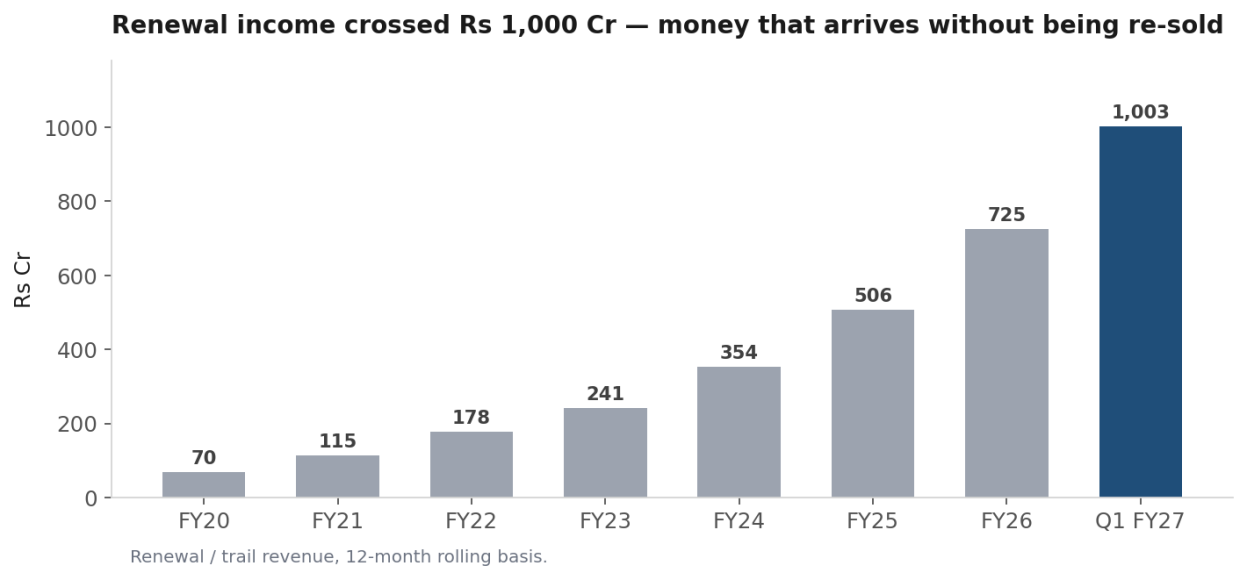
Year 2, PB does almost nothing. A reminder, a payment link, one call. Same commission, and this time PB keeps roughly 77-80 paise of every rupee.
And there is a lag. Renewals today come from policies sold two and three years ago. PB has grown fresh premium 35-48% for thirteen straight quarters, so the renewal book keeps getting bigger on its own, from business already written.
Here is management explaining exactly that on the Q1 FY27 call:
The new initiatives (the remaining 37% of revenue)
Four businesses sit here, and each one is the same platform idea pointed at a different customer.
PB Partners is the big one. Think Policybazaar but for the agents, not you. Policybazaar's app is for you. PB Partners' app is for the agent. Over 5 lakh agents sit on this platform and sell insurance to their own customers, mostly motor. The premium again goes to the insurance company, and PB Fintech earns a take rate on it, but here it has to share most of that with the agent. So the slice PB keeps is much thinner than Policybazaar.
Why do it then? Because a truck owner in a tier 4 town is never going to compare policies on a website. He calls the agent he has been using for ten years. PB Partners covers 99% of the pin codes in India, and 78% of its business now comes from tier 2 and tier 3 cities.
PB Connect is the same thing as PB Partners, but for loans instead of insurance.
PB for Business is Policybazaar for companies instead of individuals. Group health, group term, property and liability cover sold to employers. Over 21,000 corporates and SMEs.
PB UAE is simply Policybazaar run in Dubai. Same platform, different country. Profitable, and about half its book is now health and life rather than motor.
Why the margins look so different
The core business earns a 19% EBITDA margin in the quarter (21% rolling twelve months). New initiatives earn −5% EBITDA margin.
New initiatives contribution margin (think gross margin in simple language) was −60% in Mar-22 and is 7% now. But the EBITDA loss has stopped shrinking (covered more deeply in Part 4), because it is the one thing that went wrong this quarter.
One thing to know about the loan business
Inside credit, unsecured lending pays a higher take rate and secured lending pays a lower one.
A home loan is a huge ticket, so it makes the disbursal number look massive, but the fee on it is small. A personal loan or a credit card is a small ticket with a much better fee. So when you see disbursals jumping and PB's credit revenue flat or falling, that is the mix at work, not the business breaking.
That phase now looks over. Credit revenue has started growing again.
That is the whole business model. Once you have this in your head, the concalls make sense on their own.