Aditya Infotech — CP PLUS: business model, growth, margins & capacity expansion
Can Aditya Infotech keep growing sales rapidly while maintaining 14–15% EBITDA margins, expanding capacity before it becomes a bottleneck, and localising more of the camera bill of materials? Everything up to the IP vs analog section is open to everyone.
The core question
Can Aditya Infotech keep growing sales rapidly while maintaining 14–15% EBITDA margins, expanding capacity before it becomes a bottleneck, and localising more of the camera bill of materials?
Executive snapshot
So you might have seen the CP PLUS CCTV cameras at places. Yes, so that is the company we are discussing here.
Aditya Infotech is increasingly an own-brand surveillance product company rather than a pure distributor. CP PLUS was about 87% of revenue in Q1 FY27, and IP products were about 79% of the CP PLUS portfolio. The financial story is now a combination of high sales growth, a richer product mix, margin expansion, lower finance costs and an aggressive capacity and localisation programme.
| Measure | Latest | Context |
|---|---|---|
| FY26 revenue | ₹4,221 cr | +35.6% YoY |
| Q1 FY27 revenue | ₹1,402 cr | +89.5% YoY |
| FY27 revenue guidance | ₹6,000–6,500 cr | 40–50%+ growth |
| FY27 EBITDA margin guidance | 14–15% | Q1 FY27 was 14.8% |
| Current capacity | ~2.5m units/month | ~85–90% utilisation |
| Capex envelope discussed | ~₹200–300 cr | Mostly internal accruals |
The business model
Aditya Infotech sells security and surveillance products, mainly under its flagship CP PLUS brand. The company started as a technology distributor, entered video surveillance in 2007, and has progressively moved toward owning the brand, designing products, manufacturing locally and building its own R&D capabilities.
The simplest way to think about the business: component suppliers → AIL R&D and product design → Kadapa manufacturing → CP PLUS channel and customer.
The economic change is important: distributing somebody else's finished product gives Aditya Infotech a distributor margin. Designing, manufacturing and selling its own CP PLUS product allows the company to capture more of the product economics. Management has said the margin differential versus the legacy Dahua distribution model was almost 3x.
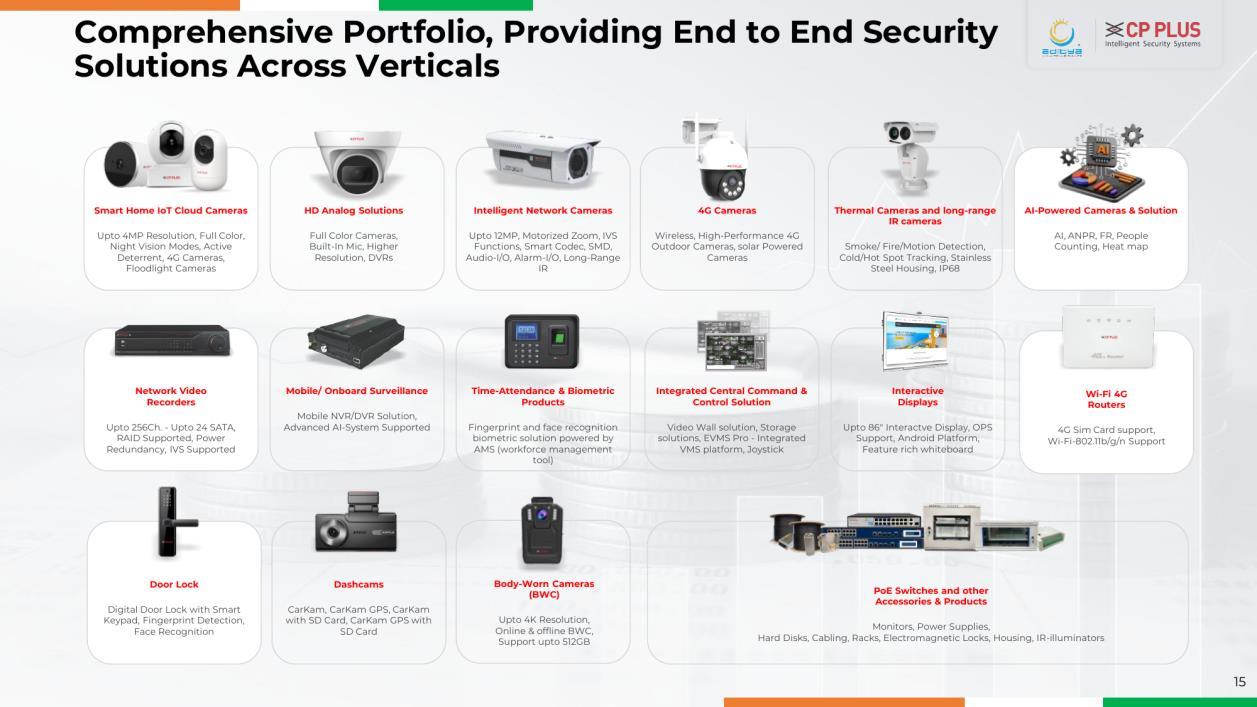
Who buys these products?
The company sells through a large channel network rather than directly bidding for every end-customer project. Its ecosystem includes 800+ distributors and 1,800+ system integrators across 500+ cities. End demand comes from homes, small and medium businesses, enterprises, industrial customers and government/public-infrastructure projects.
The business is not just "selling CCTV cameras". The important variables are brand mix, IP vs analog mix, average selling price, manufacturing scale, localisation of components, channel reach and the ability to add software/AI over time.
IP vs analog: why the mix matters
Management groups front-end cameras into three broad buckets: HD analog, IP cameras, and Wi-Fi/4G plug-and-play cameras. The important structural shift is from lower-value analog products toward higher-value IP products.
| Camera type | Simple explanation | Management view | Economics |
|---|---|---|---|
| HD analog | Lower-cost camera on traditional CCTV infrastructure | Expected to remain broadly flat | ASP about 30% of an IP camera |
| IP camera | Networked digital camera, better control, scalability and AI capability | Expected to drive most of the growth | ASP roughly 3–3.5x analog |
| Wi-Fi / 4G | Plug-and-play cameras, homes and smaller installations | Some growth expected | Another higher-value connected category |
By Q1 FY27, management said IP products were about 79% of the CP PLUS portfolio. CP PLUS itself was about 87% of total Aditya Infotech revenue. The company does not separately disclose the latest exact analog revenue share because the non-IP bucket also contains Wi-Fi/4G and other products.